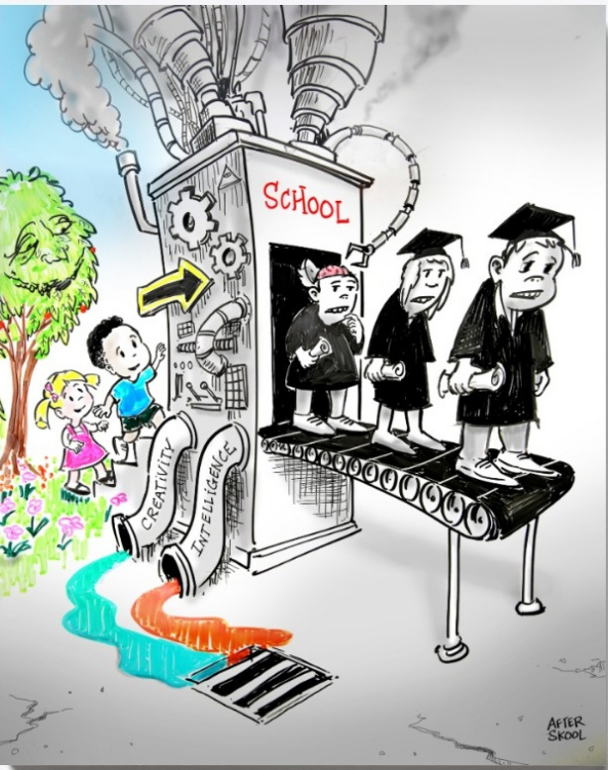
TITLE: Chapter 2: The Broken Model | A Short History of Public Schooling
AUTHOR: Khan | Class Dismissed
Talking Points:
(1) On page 70 it states, "The idea was to not produce independent thinkers, but churn out loyal and tractable citizens who learn the value of submitting to authority of parents, teachers, church, and ultimately king" I found this interesting and very slowly starting to backfire. There is a broken record that has been moving where millennials and younger generations were told "go to school, graduate, go to college, graduate, you'll get a job and it'll be great" That set back thousands of students. Although the were listening to what they were being told they all left institutions with debt in the hundreds of thousands in a job market where older generations refuse to retire from. There is a bitterness when the group who "did it right" wants to have their input on situations that won't affect them. So many missed out inventions and new ideas went into fields where they chose "stability" over "passion" because they listened.

 I fortunately have no clue who this person is however, I unfortunately couldn't contact her and politely ask what exactly history was...if not centuries of pushed politics and propaganda...I find it fascinating that she is so close to a break though.
(3)Lastly, on page 99 Khan states "The "best performing" student--that is the one with the greatest facility for catching on quickly at a certain level of understanding, and therefore the one with the highest test scores--will necessarily end up as the most accomplished scientist or engineer. That will depend on creativity, passion, and originality-things that begin where testing leaves off." This reminded me of an interview the other day with a student refugee from Afghanistan. She said in regards to the question, 'what does academic success mean to you', "I strive to be my best. I want to be able be able to understand what I am learning. I rather have a B in a topic I can understand the best of my ability than an A in the class but not understanding what I'm learning, just handing homework...assignments, not gaining anything." In her folder she did score low on her PSAT but she is striving to be a Neurosurgeon to understand her family's history of different brain traumas. She will succeed in the field because she has a passion for it and it very intelligent, but her PSAT score would do her harm.
Argument: The author argues that creativity is under appreciated and neglected from the STEM fields despite it being vital to careers and the push for test scores wears down education; the system needs to make changes.

Its also interesting that although we started to 'equally" educated everyone...there's no uniform curriculum. Students have to hope their districts are providing the right information and have the resources to give thousands of students a chance into high fields. There is no equality in public education and testing alone won't fix it.

Reflection: I didn't realize how long we have been using this Prussian Model but felt like it needed to change the last decade and especially with the effects of covid. I related to the part with Nadia (pg.100) and the math placement test. There was an opportunity in middle school to take a test to learn Algebra I in 8th grade and start Freshman year taking Geometry. I always strived to "be" smart and wanted to take the test. I have never excelled in math and just barely scraped by. I just wanted to look good on paper and have a good grade but never fully understood any unit from there to my college math gen ed. In today's society there is a vast amount of opportunities for students which can be overwhelming for children and adolescents. I've seen more montessori options, language immersion, CTE schools but to districts, their numbers matter more than the benefits of these opportunities. Furthermore, there is a disconnect between students and these opportunities. In the community people are complaining that students from out of the city get bussed in to take CTC classes and that it should be reserved for East Providence students only. However, I see a lot of students NOT wanting to take the opportunity. Are they just lazy, burnt out, or coddled?


Hi Kristy,
ReplyDeleteI liked how you focused on the quote about schools producing “tractable citizens” because it helps explain why the pressure to follow one path still feels so strong today. Your example about students being told to go to college and then facing debt and limited opportunity shows how the model assumes success will come from compliance with the steps rather than understanding individual goals or strengths.
Your point about testing and the Afghan student stood out to me too. It really shows the gap between measured ability and real capability. Passion and purpose often appear outside what a test can capture, which connects to Khan’s idea that creativity begins where testing ends.
Reading your post also made me think about how sorting does not only happen academically. In my blog I talked about the school to prison pipeline because when systems rely on uniform expectations, students who do not fit them are often removed rather than supported. Just like testing can label students as capable or not, discipline practices can signal who belongs in academic spaces and who does not.
If you’re interested, I included two short videos in my post that helped me visualize how we got here. One explains the argument through a spoken word perspective and another discusses how industrial influences shaped the structure of schooling. They helped me connect the historical model to what we still see today.
Your reflection about burnout also made sense in that context. If students feel constantly measured instead of developed, disengagement can look like laziness even when it is actually exhaustion. I wonder if some students avoid opportunities not because they lack motivation but because they no longer trust the system to recognize their strengths.
Hi Kristy!
ReplyDeleteI thought your point about pushing tests so hard that students give up on tests was particularly relevant. So many high schoolers are tested in each class and then have standardized testing and then have PSATs and SATs, and spend so much time testing that they either get stressed about it and perform worse, or they stop trying, or they only learn how to do things that are relevant on tests and ignore all other learning.
At my younger cousin's school district, they decided to try to help that problem by not having any in-class "tests". They do "knowledge checks" periodically to assess mastery, but I know for my cousin at least, the students aren't placing as much stress on that because these checks are not given as much weight as proving actual mastery is in the grading.
Combining this constant testing with an expectation that students will participate in many extracurricular activities, and also have passion projects and hobbies, sets many students up for failure. While yes, it is important to do your best and to try new things, many students spend so much energy in one area of their life that they don't have enough time or energy to complete everything on their plate. In addition to the expectations that families, colleges, and workplaces have for students, many of them also navigate the world of trying to support their family or themselves with little to no social or financial safety net, which can lead to burnout or innovation depending on the individual.
I think a lot of your points come down to the current educational system functioning as if each student is the same when they are each individuals with different strengths and needs.
Your last question is a big one: "Are they just lazy, burnt out, or coddled?" I am going to take this up in my sabbatical project next spring when I am going to study college students and the way they engage with school post-covid. While tangential to your point, I truly believe that the students who are barely showing up, not reading, scraping by are not just lazy or entitled. I think there is more going on here. Would love to talk more with you about this sometime!
ReplyDelete