Saturday, February 21, 2026

Who Would Have Thought?

Reading: Shifting the Paradigm from Deficit Oriented Schools to Asset Based Models: Why Leaders Need to Promote an Asset Orientation in our Schools

Authors: Renkly & Bertolini

Talking Points:

(1) To start, "Encouraging faculty creativity to foster students’ assets and work proactively is a first step in shifting this paradigm. Asset focused expectations must be modeled with faculty and staff by identifying their assets to determine how they can contribute to the school and community."(p.24) I felt this was spot on in the documentary we watched in class, Precious Knowledge. The teachers had a filled, colorful classroom with personal photos, pictures of leaders and focused on what the students could achieve. The students were gaining more strengths, competencies and interests in school just by having the teachers present in an alternative manner. The students were becoming more confident and invested in their learning. Teachers have a huge impact on a students view on a class. I have students who can receive a low D in one class because "I don't like what I'm learning and don't like the learning style" and an A in the other because "My teacher asks us what we want to write or read about and makes it entertaining". Keeping teenagers engaged in what their learning deserves its own award.

(2) Paraphrasing the top of page 25 we learn about external and internal assets, where external assets are provided by relationships formed with adults and the internal assets being formed for students to guide themselves. I found this to be incredibly important to this weeks reading since the readers are being informed that it will take a village to have successful students. They state the more assets students have its less likely students will exhibit risky behaviors. I've interviewed students for two years now and notice with Pawtucket we get lengthy discplinary records from students who attended Slater for middle school but are completely clean when they move into our target high school. One applicant stands out that I interviewed last month. On paper he seemed like he would create chaos being involved in our program from his 20 page discipline record from middle school (currently in 9th). When I got to speak with him I was interviewing a completely different person. He was calm, explained his issues, and he was lucky enough to have a caring mother to recognize his acting out and put him in Taekwondo. He had severe culture shock coming from another country, had teachers writing him up left and right, when he needed more guidance. I'm excited for him to start our program and meet more students and teachers who want to put in the time for him to express himself and find community.

(3) Later on that same page it states, "Scales et al. (2000) note that student time spent in youth programs is one of the most predictive elements to a child's thriving outcomes. Good youth programs are tied tightly with the community and provide students with access to caring adults, while also instilling the importance of leadership. helping others, and maintaining good health." After reading this week I do recognize that Upward Bound could be changed slightly, however, overall you can see the difference in students who make it through their first summer in the program. When students come to our program they are getting an almost personal guidance counselor. An adult who has more time to spend with them, helping them create their future. They have teachers, many who are alum of the program, willingly come to teach on Saturday mornings and in the Summer to get them more engaged. They find a community of students with the same goal of becoming the first to go to college. Many of these students may not have all these things in their own schools or at home. They start to branch out and join clubs and sports, volunteering with our program because they have people in their lives encouraging them. We have graduations and different awards nights to invite families to see what an impact our program has on them. We have "most improved" awards to shine light on those who did struggle in a subject and worked with their Tutor Counselors and teachers to power through. We have a One World Festival showcasing to families and the community what 60 students can learn in their language classes in 6 weeks followed by a fashion show. We have a few parents after every summer coming up to us saying how much their children have grown. My own mother included. I was a reserved child but from having the opportunity, guidance, and encouragement I completely came out of my shell. We are a great environment to support students and their families.

ArgumentRenkly & Bertolini argue that by moving students into an asset based model from a deficit one, there are better outcomes expected through community involvement, engagement, and collaboration.

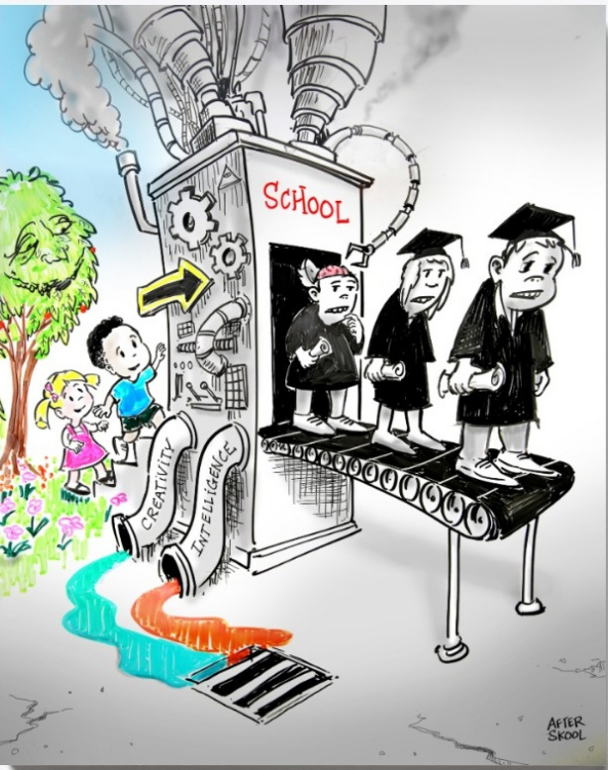
Connections - The Ted Talk was very insightful and the presenter, Sugata Mitra, was entertaining to watch. He said, "How come all the rich people are having these extraordinarily gifted children? What did the poor do wrong?" Its known that talent is everywhere but opportunity is not. As a society we would be lightyears ahead if we focused on the potential of every individual instead of having that overbearing need of unappreciated "essential workers" to push out. This connects in last weeks video referencing the "cogs" and just growing up to be another worker. By having this asset model with providing children with a computer and no other directions, students went out of their ways to find answers. Children's brains are sponges and can take in such information especially when they're in the "why" stage. All Mitra had to do was show up and have a student led learning process and now they were teaching him about DNA.  


Reflection - I enjoyed this weeks topic. I felt in the last few years how the Prussian model is holding students back from potential. Like I mentioned in my last post there has been a surge of montessori, language immersion, and CTE classes in the education system that don't align with the current model. I have a student who didn't feel challenged enough in her high school calculus class and sought out to take ACN courses in BOTH calculus and computer science. She is a brainiac but wouldn't have been able to reach these opportunities like receiving $225,000 in scholarship to attend WPI if she didn't have a strong support system both in our program, at school, and at home. Even with the amazing scholarship she is nervous about not having the money for the enrollment and housing deposit. She is still applying to every STEM and Women of Color opportunities along with our UB scholarship to get her to achieve her dreams.


P.S. Unrelated: This was my week to bring in snacks for Thursdays class and I'm upset because I specifically went to Costco to get nutella beignets for you all to try and the blizzard ruined it...anyways I didn't want them to go stale and they are really good heated in the microwave for 10 seconds...

Friday, February 13, 2026

Test Scores ≠ Student Capabilities


Schooling System Humor | SuperMemo.wiki

TITLE: Chapter 2: The Broken Model | A Short History of Public Schooling

AUTHOR: Khan | Class Dismissed 


Talking Points: 

(1) On page 70 it states, "The idea was to not produce independent thinkers, but churn out loyal and tractable citizens who learn the value of submitting to authority of parents, teachers, church, and ultimately king" I found this interesting and very slowly starting to backfire. There is a broken record that has been moving where millennials and younger generations were told "go to school, graduate, go to college, graduate, you'll get a job and it'll be great" That set back thousands of students. Although the were listening to what they were being told they all left institutions with debt in the hundreds of thousands in a job market where older generations refuse to retire from. There is a bitterness when the group who "did it right" wants to have their input on situations that won't affect them. So many missed out inventions and new ideas went into fields where they chose "stability" over "passion" because they listened.

(2) The last sentence on page 80 and continued onto page 81, Khan says, "Prussian-based public school model has come under attack from both the left and the right. Conservative complain tend to center on the alleged usurpation by government of choice and prerogatives more properly left to parents...Attacks from the left have tended to be surprisingly similar in tone, though the villain is not the government but the corporations that have the most to gain from a well-behaved and conformist population." The left view is mentioned by Laurie Couture from the Class Dismissed clip and connects to the talking point above regarding them to be "cogs". This link connects to a research study in showing how the parties view what's wrong with schooling. I find it intriguing that the right is focused on students not spending time on core subjects but also not viewing the lack of funding as an issue when they could go hand in hand. 


I fortunately have no clue who this person is however, I unfortunately couldn't contact her and politely ask what exactly history was...if not centuries of pushed politics and propaganda...I find it fascinating that she is so close to a break though.


(3)Lastly, on page 99 Khan states "The "best performing" student--that is the one with the greatest facility for catching on quickly at a certain level of understanding, and therefore the one with the highest test scores--will necessarily end up as the most accomplished scientist or engineer. That will depend on creativity, passion, and originality-things that begin where testing leaves off." This reminded me of an interview the other day with a student refugee from Afghanistan. She said in regards to the question, 'what does academic success mean to you', "I strive to be my best. I want to be able be able to understand what I am learning. I rather have a B in a topic I can understand the best of my ability than an A in the class but not understanding what I'm learning, just handing homework...assignments, not gaining anything." In her folder she did score low on her PSAT but she is striving to be a Neurosurgeon to understand her family's history of different brain traumas. She will succeed in the field because she has a passion for it and it very intelligent, but her PSAT score would do her harm.

Argument: The author argues that creativity is under appreciated and neglected from the STEM fields despite it being vital to careers and the push for test scores wears down education; the system needs to make changes.

Connections: Providence schools drill standardized testing to their students. I work in Hope High School out of our three targeted and I believe the students are so burnt out they've given up. PSAT, SAT, etc. It hurts our annual performance in Upward Bound because a student who took their first PSAT in 9th grade trying their best and now they're juniors on their 3rd or 4th PSAT before the Spring SAT they've given up. Our program needs good scores in order to receive their funding and we have bright students but they're tired of it. 

Its also interesting that although we started to 'equally" educated everyone...there's no uniform curriculum. Students have to hope their districts are providing the right information and have the resources to give thousands of students a chance into high fields. There is no equality in public education and testing alone won't fix it. 

Another issue is that this strict testing is a global problem. In Korea the government shuts down any air travel so students aren't distracted during their EXTREMELY important exam. While its very nice for the entire government to do this, it seems very unnecessary that the importance of this test affects elements outside the classroom. In China it is normal for student desk to look like this when they reach their test dates. In the United Kingdom, they have GCSE's which cause students thier own stress and A-Levels for specialized classes. Around the world testing is haunting students.

Reflection: I didn't realize how long we have been using this Prussian Model but felt like it needed to change the last decade and especially with the effects of covid. I related to the part with Nadia (pg.100) and the math placement test. There was an opportunity in middle school to take a test to learn Algebra I in 8th grade and start Freshman year taking Geometry. I always strived to "be" smart and wanted to take the test. I have never excelled in math and just barely scraped by. I just wanted to look good on paper and have a good grade but never fully understood any unit from there to my college math gen ed. In today's society there is a vast amount of opportunities for students which can be overwhelming for children and adolescents. I've seen more montessori options, language immersion, CTE schools but to districts, their numbers matter more than the benefits of these opportunities. Furthermore, there is a disconnect between students and these opportunities. In the community people are complaining that students from out of the city get bussed in to take CTC classes and that it should be reserved for East Providence students only. However, I see a lot of students NOT wanting to take the opportunity. Are they just lazy, burnt out, or coddled?

Saturday, February 7, 2026

You Don't See Color...What Do You Do At A Traffic Light? - Blog Two

Author: Margalynne J. Armstrong and Stephanie M. Wildman | Mellody Hobson

Title: "Colorblindness is the New Racism" | "Color Blind or Color Brave" 


Talking Points:

(1)  The authors explain, "Color insight contrasts with colorblindness by offering an alternative that better serves the purported goals of colorblindness: racial equality and justice. Color insight requires its practitioners to observe, discuss, and analyze the operation of race and privilege in contemporary society"(pg.68). There's an interview that repeatedly kept playing in my head as I was reading from Trevor Noah where he says "there's nothing wrong with seeing color, it's how you treat color that's more important." after the white, blonde haired woman says she doesn't "see" color and claiming to also go after a white woman politician. Noah offers to explain how negative colorblindness is and despite his efforts to educate, she immediately attacks by saying "when you start to loot, burn and riot". She is becoming more enraged and defensive than when she mentioned another white woman politician. Earlier on page 66 it states, "Whites often do not think about race and racial justice except when they notice people of color present" and that interview is a clear example of why it needs to be spoken more and not ignored. 

(2) On page 73 I found the Race Neutral Hypotheticals exercise of the attorney and the plaintiff suing for the improper dose of anesthesia administered before surgery interesting because I pictured the plaintiff as either someone with ginger hair and their resistance to some anesthesias or a black woman due to the significant neglect they experience in the medical field. At the end of the section it mentions that "teachers can help students make privilege visible and deepen their understanding of it operation." By having that tough conversation to students to recognize color exists beyond their own identity and for them to see that race can have real disgusting disadvantages, they are able to see through a lens that could help society in the future.

(3) In the Ted Talk, Hobson states at the end, "We have to be color brave. We have to be willing, as teachers and parents and entrepreneurs and scientists...to have proactive conversations about race with honesty and understanding and courage, not because it's the right thing to do, but because it's the smart thing to do, because our businesses and our products and our science, our research, all of that will be better with greater diversity." It seems that one of the few environments we see the actual progress of color bravery being a success is in the Olympics with our heterogenous society racking up thousands of medals throughout the years, and even then it took a long time for this and athletes still facing backlash/racism for embracing their background and their experiences of oppression. By having different people with different strengths; coming together will amount to great success.


Argument Statement: The authors Armstrong, Wildman and presenter Hobson all argue that society needs to embrace the conversation of color to enhance success in the workplace, the community, and schools rather than ignoring color and race, brushing it under the rug.

Connections: One connection I found in the article was on page 65, "...white plaintiffs sued to end programs that had sought to promote the inclusion of people of color in education and employment opportunities that previously had been foreclosed to them" In my sector, I've seen countless complaints from people asking where the 'white scholarships are', 'why does race need to matter?' 'everyone should have the same opportunity', their attempts at colorblindness completely ignoring the exact reason why the scholarships exist in creating equity. Also, last year TRIO was being severely attacked by the administration to be cut, mentioning that college is now accessible for those who want to go and in result there have been over 100 divisions canceled. Although anyone who is eligible to participate, a majority are students of color across all different TRIO programs in the country. Their implicit bias is screwing over thousands of white students especially in rural areas as well but to them it's a small cost to pay. If our programs were majority white populated there would be no head turning. We are now forced to rewrite our next Grant Proposal carefully not to include any mention of culture or inclusion. 

Reflection: I'm privileged to work in a very diverse office of individuals who proudly display their backgrounds; sharing stories, ideas, knowledge. Being able to work in the environment allows me to easily take part in color brave/color insight conversation as an observer, analyst and to sympathize in conversations. We all have different parts of our background that helps our work tremendously in a possible comparison if all the "Fortune 500 employees" were in the room. If a team had 10 different individuals who had knowledge and background to speak on, they'd be greater than the same person copied over 9 times with the same background and ideas. If colorblindness existed all of our students from Upward Bound to McNair scholars wouldn't be able to proudly display who they are and what they're capable of. We are successful because we are embracing the diversity in the work place of colleagues and in the education of students.

Sunday, February 1, 2026

All of us are the Problem - Blog One

Author: Alan Johnson

Title: Privilege, Power, Difference


Talking Points:

(1)  In Johnson's writing he immediately begins with the elephant in the room. He mentions "you can't deal with a problem if you don't name it; once you name it, you can think, talk, and write about it (pg. 11). Topics mentioning any diversity outside of the majority are often at times shot down; whether it regards to inequality of race, gender, class etc. because it makes some feel uneasy and defensive, even feeling imaginary guilt. 

(2) Later in the reading the author is addressing the fact that many social constructs are the root of the issue. He references James Baldwin on page 21 saying "..most of what we experience as "real" is a cultural creation...it's made up, even though we don't experience it that way". This reminds me of my undergrad when Professor Harkness challenged the class in what is considered a social construct. At first it was easy but as he went on the class took longer to decide, having students debate what we believed was to be true and authentic. Furthermore, the constructs are always changing. Like mentioned, the Irish and Italians were met with discrimination once they came flooding in to the States. Over time they have joined the majority. However, once passing the threshold of oppression they tore apart the next group of people rather than using their new privilege to help one another. This segue into the third talking point.

(3) Toward the end of the reading Johnson informs the audience of the concepts being versus feeling privileged in Chapter 3 on the end of page 36. The external presentation of privilege doesn't equate to the internal feeling. In my work we interview students between 14-18 years old to enter our program. We are government funded and have to ask specific census-like questions including 'what's a students ethnicity and race'. We had a student last year who was white and listed their ethnicity as 'New Englander'. On the other hand we always have a handful of students who will have Puerto Rico or Dominican listed on ethnicity and leave race blank because they do have a light complexion but internally aren't feeling that white privilege. We live in a society that wants to label everything but then rejects when people want to label themselves.

Argument Statement: This author argues that although people didn't choose their privileges due to the structures they were born into, it is crucial to address the powers, differences, and oppressions of their own backgrounds in order to propel society into being able to "treat one another with decency and respect and appreciate if not support the best we have in us".

Connections: An easy comparison of these social constructs and effects can be found in Jane Elliot's Blue Eye and Brown Eye Experiment. The second students find out their eyes give privilege they immediately change their attitude. Prior to their newly labeled lives, in an all white classroom they didn't see that much of their privilege until "society" decided some of them have privilege and others discovered what oppression is.


Reflections:
To reflect on this with my personal experience, I started the Upward Bound program when I was a freshman in high school. I went to a predominately white school and entered a space where I was 1 of 5 white presenting students out of 105. Although I didn't feel too uncomfortable not having majority of people who looked like me in there, 
I can't imagine what a young black student would feel entering a space with 100 white students with the privilege they are perceived to have. Being in the program really opened my eyes to all different cultures, backgrounds, and had uncomfortable conversations that led my to my love for Sociology in college. 


Teach Out Reflection

       In the Teach Out project I chose to focus on the reading, Shifting the Paradigm from Deficit Oriented Schools to Asset Based Models:...